

C
hoosing a vacation destination — or even merely a hotel room — can be a decision fraught with emotions and uncertainty. The University of Florida’s Eric Friedheim Tourism Institute has high-tech answers for that.
As a bridge between leading-edge research and tourism-industry needs, the institute is at a pivotal, invigorating moment. Its research output is crucial to nurturing Florida’s largest industry, institute Director Rachel J. C. Fu says. That means focusing on artificial intelligence, robotics and Big Data analytics to make tourism-related businesses more insightful and responsive.
“AI and robotics are not optional. They’re the future of tourism and hospitality,” says Fu, a professor and chair of the tourism, hospitality and event management department in the College of Health and Human Performance.

In other parts of the world, robots are already cleaning hotel rooms, delivering room service and handling some guest services. In the United States, those practices are catching on more slowly. EFTI, Fu says, is poised to lead the way: Technology like AI and robots can make travel smoother and more enjoyable for guests — and more efficient for businesses.
For Fu and the EFTI, Big Data and AI are just part of the picture. Institute researchers have written the blueprint for the cruise industry’s pandemic response, produced groundbreaking work on overtourism and brought clarity to the sometimes dizzying world of online hotel reviews.
EFTI’s research findings are powerful assets that drive service innovation across the restaurant and hospitality industries, says Bob Schalow of Diversified Restaurant Group. The institute’s work translates complex data analytics, AI applications, and consumer-behavior modeling into practical strategies. That helps companies personalize guest experiences, optimize labor and supply-chain systems and reimagine service delivery with automation and robotics, he notes.
“For hospitality leaders seeking to stay competitive in a rapidly evolving landscape, EFTI’s research serves as both a road map and a catalyst for smarter, tech-enabled decision making,” says Schalow, an EFTI Industry Advisory Board member and senior vice president at DRG, which operates more than 300 restaurants.
Virtual Vacation
When Andrei Kirilenko was studying climate change a decade ago, he wasn’t thinking about a career in tourism research. Ultimately, that partial career pivot ended up feeling very natural.
“I think of myself as a data scientist,” says Kirilenko, an associate professor in the Department of Tourism, Hospitality and Event Management.
Now, he uses technology to reveal prospective tourists’ excitement or fear about travel destinations. Bringing a methodical, data-driven approach to travel decisions benefits tourists and businesses alike: Booking an expensive, non-refundable trip can be a stressful process. Meanwhile, businesses often struggle to tailor their messages to different types of travelers. Emotional arousal matters because tourists can’t sample a travel experience before committing.
You can’t preview a vacation. You have to just decide — either I’m going or I’m not.” — Andrei Kirilenko

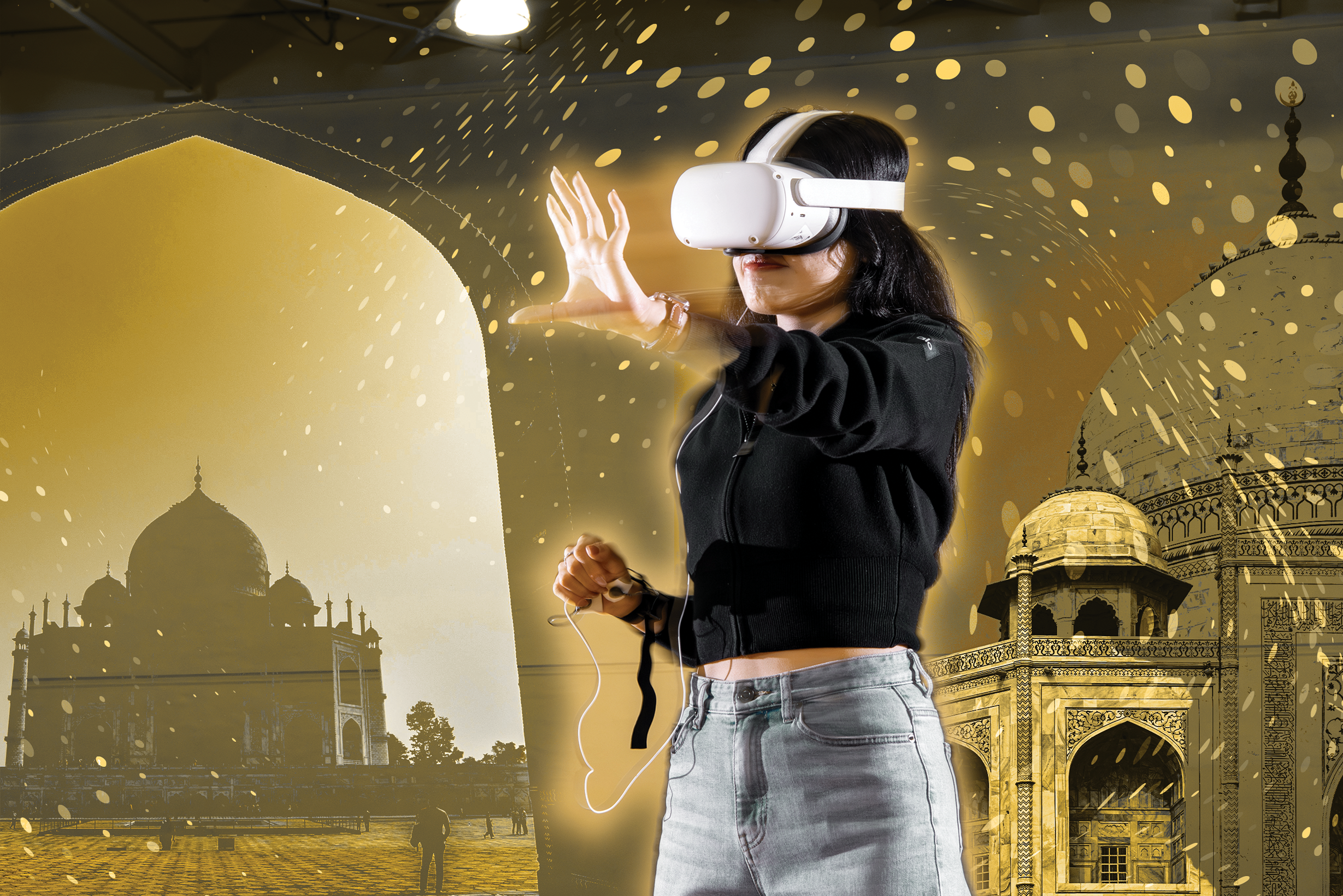
In his virtual reality lab, heart rate monitors and skin conductance sensors measure study participants’ reactions to tourist destinations. The data are paired with questionnaires that help researchers understand what motivates travelers. Some people want to see real, ancient artifacts.
Others are less concerned about authenticity and might prefer a replica of an entire village. A 2025 study by Kirilenko and his colleagues revealed how participants’ heart rates reflected their emotional engagement with virtual reality videos of Hobbiton. The New Zealand movie set and tourist attraction replicates a hobbit village from “The Lord of the Rings” and “The Hobbit.”
The findings showed how emotions can shape pre-visit perceptions and offered evidence for how marketing materials can be tailored to people with different “tourism personalities.”
“Physiology doesn’t lie to us,” Kirilenko says.
UF is one of just a few academic institutions in the world using data mining, artificial intelligence and physiological sensors for tourism research, according to Kirilenko. More broadly, EFTI has hosted an array of Kirilenko’s research projects focusing on overtourism, virtual reality travel and AI-assisted research.

EFTI Ph.D. students Jiwoo Jung (left) and Rezvan Eftekhary show the virtual reality equipment used in tourism research.
After gathering data from the Miami, Orlando, St. Augustine and Panhandle tourist markets, the researchers found that one-third of residents wanted fewer tourists even before environmental or infrastructural crises emerged. Tourism also affected residents’ perception of quality-of-life issues such as racial inclusion and crime in ways that weren’t necessarily accurate, the researchers determined. Using data to identify the early signs of overtourism shifts the debate from anecdotal protest narratives to methodical “destination management,” Kirilenko says.
“Detecting discontent with overtourism before it evolves into open hostility or policy backlash — as seen in Venice or Barcelona — is essential for sustaining tourism growth,” the researchers wrote.
People as Sensors
The overtourism study and others by Kirilenko make use of one of his preferred — and most powerful tools — people as sensors. He explains it this way: Most of us leave footprints, either actual or digital ones, in life. Much of that can be captured and analyzed by AI and Big Data, revealing otherwise hidden clues about travel and recreational habits. For Kirilenko, that has included mining Instagram for recreation patterns at a large lake on the Texas-Oklahoma border. That helped the U.S. Army Corps of Engineers better understand how the area was being used for recreation.
Kirilenko has also analyzed social media posts to better understand tourists’ “co-visitation” habits — the sites and activities people are grouping together. The goal, he says, was to discover the less-explored parts of Florida to drive return visits from U.S. visitors and spark international tourists’ interest in new destinations.
“All of us are sensors in our environments. If I observe the individual social media habits of enough people, I can draw bigger-picture conclusions,” Kirilenko says.
One of his ongoing projects involves identifying ecotourism hotspots around the country. To do that, he’s mining data from more than 2 million people who use a plant and animal-identification app — more than 1 billion species identifications in all. Whether it’s butterflies, bees or mushrooms, Kirilenko is crowdsourcing biodiversity hotspots. Ecotourists can easily learn where their favorite species are clustered and city officials can use the details to promote those activities, he says. So far, the analysis has turned up one notable surprise: Biodiversity in urban Detroit, where nature is reclaiming neglected neighborhoods.
That, Kirilenko says, underscores the power and precision of Big Data analysis in everything from public opinions about climate change to finding hidden troves of plants and animals.
“For me, Big Data is like a gift from God,” he says.
Building A Better Robot
For travelers who encounter a service robot or find clarity in a morass of online hotel reviews, Hengxuan “Oscar” Chi is a driving force behind those experiences. Chi, an assistant professor of tourism, studies the impact of AI and other technology on the delivery of services — especially in hospitality and tourism.
People’s perception drives everything.”
— Hengxuan Chi
That idea propels much of his research, which includes designing more appealing robots for service industries and helping consumers and business owners better understand online hotel reviews.
With robots, Chi is working to unravel a dilemma. Customers often respond positively when robots show humanlike behavior. Yet there’s also a limit to that: Robots with overly human features aren’t always better received by customers.
To help hospitality businesses choose or design optimal robots, Chi developed a four-dimensional scale to boost the machines’ perception as humanlike. That includes a human appearance; social intelligence that emphasizes responsive, natural interactions; “emotional awareness” that reacts to customers’ moods; and self-awareness that suggests a degree of “personality.”

Hengxuan “Oscar” Chi, an assistant professor in the Department of Tourism, Hospitality and Event Management.
Some of those traits matter more than others. A service robot’s social and emotional intelligence are more impactful than its appearance, Chi notes. A new EFTI-funded study will test which robot features matter most to hotel guests.
“Developers believe humanlike robots perform better — but is that true?” Chi says.
Having relatable robots is something of an imperative for the hotel industry, he notes. A confluence of factors is pushing the hospitality industry toward more automation. Hotels in Europe and Asia are already making significant use of robots for cleaning, room service, guest check-in and basic, information-related services. For U.S. hotels, Chi says, that level of automation is coming eventually.
“Unlike retail shopping, customers expect a certain level of human interaction within a hotel,” he says.
Chi’s other work has delved into a dilemma that many travelers face repeatedly: How much to trust AI-generated hotel reviews versus those created by humans. Popular hotels and restaurants may have thousands of reviews, creating information overload for consumers. To address that, major travel websites deployed AI to produce concise, readable summaries of customer feedback.
Chi set out to learn how AI summaries affect customers’ decision making — and whether people react differently to AI and human reviews. To answer those questions, about 800 study participants were randomly assigned to read one of two hotel review summaries. The content of both reviews was identical, with the only difference being its label as AI-generated or written by a human traveler.
The review was labeled as being written by either “Olivia Bennett” or a language model called ReviewGPT.
“Amazing hospitality management with seamless and dedicated 24/7 customer service. Nice rooms with good views. Very beautiful and clean property. Extra courteous staff eager to assist and help you. …” the review said.
Among the study participants, positive reviews written by humans were deemed more trustworthy than AI, Chi found. The human-authored reviews were also associated with stronger intentions to complete a booking. Negative reviews from AI and humans influenced travelers’ decisions equally.
The study participants also trusted human reviews more, leading them to spend 25% more time scrutinizing AI reviews. That suggests people process AI-generated content more carefully and pay closer attention to the details it presents. Ultimately, Chi says, both approaches have value: Travelers’ reviews offer the emotional authenticity of human feedback. AI delivers clear, efficient summaries from large volumes of customer opinions.
“Picking a vacation spot is a very emotional decision, while AI is cold and factual,” he says.
Going forward, Chi says further integrating technology into service industries — especially tourism and hospitality — is an imperative. Yet he’s also thinking deeply about whether that technology has a tipping point of diminishing benefits. He asks the big, provocative question: How much technology does a particular industry — or society — need?
“My focus in the future is also to see where we should stop with technology development,” he says.
Real-world Relevance
EFTI’s evidence-based research translates abstract consumer and market signals into actionable guidance for the hospitality industry, says Pavan Kapur, chief strategy officer at Dreamscape Hospitality and president of Shanti Consulting. In particular, the institute’s analyses of demand, pricing and consumer behavior allow cruise line companies to optimize price and service offerings to match evolving traveler preferences. Among other businesses, EFTI’s work helps loyalty-program providers as well as gaming- and entertainment-focused properties optimize their product and pricing strategy, according to Kapur.
“For industry leaders looking ahead, EFTI scholars’ white papers provide not just insight but a research-backed roadmap to boost customer satisfaction, operational efficiency and long-term growth in an increasingly data-driven hospitality world,” says Kapur, who is also a member of the institute’s Industry Advisory Board.

Fu, the EFTI director, says the institute’s distinctiveness stems from its blend of academic rigor, student preparation and industry relevance. A new program offering a master’s degree in AI-driven hospitality is expected to launch in early 2027 at UF’s nascent Jacksonville campus. That assures a new generation of hospitality leaders and managers will be conversant with relevant AI technologies while also offering new skills to those already in the industry or looking for a career change, Fu says.
Likewise, crucial research on topics such as overtourism and the cruise industry’s strategies amid a pandemic are potentially transformational and unlikely to have happened without EFTI, Fu says. The cruise industry research, published in 2025, provided new insights into how pricing, vaccine perceptions and cruise companies’ health-protecting behaviors influenced traveler’s interest in cruises.
EFTI’s efforts are important for travelers, policymakers and businesses alike, Fu says. Government leaders who make decisions about infrastructure and tourism-related policies are better informed due to overtourism research. Travelers benefit from EFTI’s work on robots and AI solutions. Hospitality companies learn ways to leverage AI for improved customer service, logistics and marketing.
AI is not just a tool. It provides essential infrastructure for the tourism and hospitality industries and travel research.” — Rachel Fu
Sources:
Hengxuan “Oscar” Chi
Assistant Professor of Tourism, Hospitality and Event Management
h.chi@ufl.edu
Rachel Fu
Director, Eric Friedheim Tourism Institute
Professor and Chair, Department of Tourism, Hospitality and Event ManagementProfessor of Information Systems and Operations Management
racheljuichifu@ufl.edu
Andrei Kirilenko
Associate Professor of Tourism, Hospitality and Event Management
andrei.kirilenko@ufl.edu
Hear the Story
The audio version of this story is available on our YouTube.