


The look in her eyes and her next words would be etched forever in the mind of Dr. Elias Sayour.
Months earlier, the girl’s right leg was amputated, the best chance to rid her body of cancer. But the cancer came back anyway, this time in her lung.
The young teenager understood exactly what this meant.
If you knew the cancer was gonna come back, she asked Sayour, why’d you cut off my leg?
He’d made the best decision he could with the information he had. But such experiences during his pediatric oncology fellowship shifted something deep inside Sayour, seeding what would become an urgent refrain. He saw preschoolers with permanent brain damage from radiation or surgery. Kids who died of infections or other complications after chemotherapy.
Framed photos of patients lost began taking up permanent residence on his office bookshelves.
Everything he’d dreamt about and worked toward for years had led to this point, but now, he wasn’t so sure about this path and its pain. He viewed the treatments he was dispensing as crude. Even when they cured, the cost seemed too great.
Sayour couldn’t stop thinking about what he’d learned during his residency in general pediatrics, about the gold standard of disease prevention in children, the guardian angel: Vaccines.
“I wish,” he told a colleague, “there was a cancer vaccine.”
His colleague smiled knowingly. “You have to meet this guy, Duane Mitchell.”
The moment would mark the start of a giant career pivot, from primarily caring for patients to conducting research and then shepherding it from the lab to human clinical trials. His “more heart than head” instinct told him this was the path of hope.
Specifically, he would focus on mRNA cancer vaccines.
He could see a glimmer of their potential to “wake up” the immune system against cancer.
What he didn’t know, couldn’t know, is that a future global pandemic would accelerate the development of mRNA-based vaccines — creating an unexpected opportunity to test a hypothesis for cancer treatment.
Taking Care of Others
Growing up in Brooklyn, New York, Sayour visited his own pediatrician more often than just for the annual checkup, as he was prone to stomach viruses. Even as a 6-year-old boy, he noticed the comfort offered by his doctor.
“I remember kind of being enamored with this idea of taking care of others,” he recalls.
He could see himself in that role, and the vision became a guiding force when he felt out of place.

In school, he noticed his packed lunches looked different from the other kids’, and he spoke differently, too, having not yet mastered English. At home in his tight-knit family, he and two sisters, one older and one younger, spoke Arabic with their Syrian-immigrant parents. His dad, an electrical engineer, rose from an entry-level position to become senior vice president of a fire alarm systems company; his mom devoted herself to her children and encouraged them to pursue their passions.
After years of intense focus on academics at his all-boys Catholic high school, Sayour let loose a bit at Fordham University. At one point, he let his GPA sink to 2.7 and risked losing his scholarship.
“There’s no way you’re going to medical school,” he heard more than once.
Looking back on that bumpy time, he says, “I think that’s why it’s so important to have that initial seed of belief. I credit my mom with that, planting that original seed.”
He was less concerned with proving himself to doubters and more with showing himself he could do it. He embraced Emerson: “To finish the moment, to find the journey’s end in every step of the road, to live the greatest number of good hours, is wisdom.”
Against the guidance of his adviser, Sayour doubled down: He added a second major, biology plus chemistry, and got serious. He lifted his GPA to 3.8.
In medical school at the University of Buffalo, he’d often go without a winter coat, even on subzero days. A coat signaled you were leaving the hospital, and back then the expectation was that med students never left.
For his residency in general pediatrics, he trained at a busy New York City clinic, at times relying on his limited Spanish. He struggled to get along with his attending physicians, who criticized him for moving too slowly.
“It felt like McDonald’s for health care,” he says. “Like, just get them in and get them out. I didn’t feel like I was giving patients comfort. I didn’t feel like I was giving them time.”
It came to a head one day when an infant was brought in for a postpartum weight check. When Sayour checked the chart, the newborn screening was positive for a devastating diagnosis, a rare genetic disorder that typically means death before age 2.
Sayour spent close to an hour with the mom, explaining the findings and offering all the support he could. But when he stepped out of the exam room, his attending physician berated him for spending too long on the weight check.
He felt a dream die that day, he says, and still grimaces talking about it. “The baby has Krabbe leukodystrophy,” he attempted to clarify. The attending snapped: “You let the geneticist worry about that.”
Sayour knew his long-planned path had to change. He recalled that in his hematology-oncology rotation in med school, he was able to care for the whole patient.
“Nobody was telling me I spent too much time with a patient,” he says. “And that mattered to me.”
He headed to Duke University for a fellowship in pediatric hematology-oncology. One of his mentors there, Dr. Jennifer Rothman, remembers him as hardworking and modest.
“He was one of those quiet, smart, engaging, compassionate worker bees who never drew attention to himself,” Rothman says. “He feels things deeply. He’s just a great soul.”
Months into his fellowship, as his dismay over insufficient treatment options grew, Sayour heard about Dr. Duane Mitchell and his work on therapeutic vaccines for brain cancer.
In their first meeting, Sayour described his anguish over side effects. Mitchell nodded.
“This is unacceptable,” Mitchell said. “We need to do something about it. We need to attack cancer in a focused, targeted way that spares normal tissue.”
For once, Sayour says, “I actually felt seen.”
Mitchell’s lab was already at capacity for trainees that year, 2011. But he could see Sayour’s passion and agreed to stretch his staff.
That’s when Sayour first learned about the concept of RNA vaccines for cancer. Soon, he would focus on a type called mRNA — long before those four letters would become a household term during the COVID pandemic.
Sayour’s first assignment was as project leader for a new grant to develop cancer vaccines by combining lipid nanoparticles and mRNA, an innovative technique that was showing promise in early mouse studies.
Short for messenger RNA, mRNA is a molecule found inside every cell — including tumor cells — and carries the instructions from our DNA for making proteins. In cancer vaccines, mRNA works by using our own cells to produce harmless fragments of a target protein. Our immune system then reacts to this protein, attacking it and creating an effective response for the future.
While vaccines to prevent infectious diseases train the immune system to recognize and react to specific viruses or bacteria, the goal with cancer vaccines is to recognize existing malignant cells as the invaders, augmenting other treatments.
Mitchell’s lab employs what’s known as a translational approach, using mouse models and cells from human tumor biopsies to develop new treatments, then scaling them up, manufacturing them and testing them in first-of-their-kind human clinical trials. It’s a painstaking process that takes years of work and millions of dollars from the government, foundations and donors to accomplish.
For Sayour, the plan was to spend a single year in the lab while continuing to care for patients. But a few months in, he asked Mitchell if he could stay on and start a Ph.D.
“There are a lot of people who pursue research because they love science, and they like the idea of discovery,” Mitchell says. “And then there are a smaller number who really believe that ‘If I dedicate my life to this endeavor, we might be able to make a difference for other people.’
“Elias had that drive.”
Years later, after suffering many early grant rejections, Sayour would evolve into a prolific grant writer, telling compelling stories with hypotheses and data. He would build a robust funding portfolio comparable to any of the country’s top investigators.
His tenacity was something Mitchell saw from the beginning.
I’ve had fellows who start fast, but they don’t have the resilience to get through the difficult stages of research,” he says, “and others who, though nothing seems to be working for a long time, there’s no quit in them. They always come through with amazing results over time. And Elias had that combination of being brilliant but also extremely resilient and extremely persistent.” -Duane A. Mitchell, M.D., Ph.D.
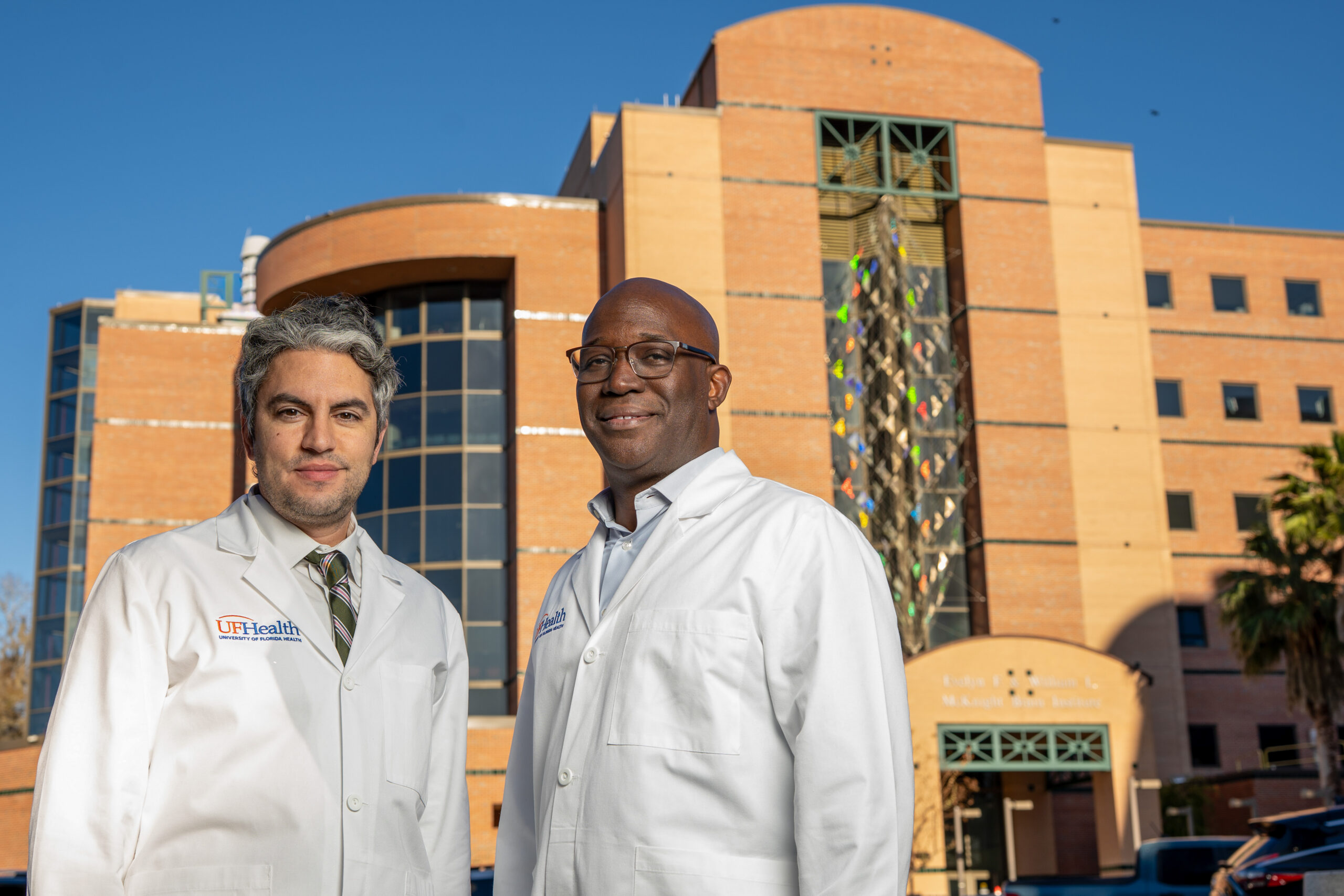
So, in 2013, when Mitchell was recruited to the University of Florida and offered the chance to bring his own team and build a new Brain Tumor Immunotherapy Program within the Preston A. Wells Jr. Center for Brain Tumor Therapy, Sayour was one of his first hires.
At UF’s McKnight Brain Institute, Sayour dove into developing personalized mRNA cancer vaccines, using an individual’s own extracted tumor cells to create custom vaccines. Early results in mouse models showed that his high-tech method could quickly reprogram the immune system to attack glioblastoma, a notoriously treatment-resistant brain cancer with a prognosis of 12 to 18 months.
It was during these preclinical experiments that Sayour stumbled upon an incredible discovery: The mRNA vaccines didn’t have to be personalized. To his surprise, even completely nonspecific mRNA vaccines, which were used in a control group, could, in Sayour’s words, “wake up the sleeping giant that is the immune system to fight cancer.”
An Emerging Paradigm
For three decades, two main ideas have dominated cancer-vaccine development: to identify a specific target expressed in many people with cancer, or to tailor a personalized vaccine that’s specific to proteins expressed within a patient’s own tumor.
Sayour’s work suggested a third emerging paradigm.
What he found was that by pairing his patented experimental “nonspecific” vaccine with standard anticancer drugs called immune checkpoint inhibitors, he could trigger a strong antitumor response in lab mice. His formulation was “nonspecific” in that it was designed not to target cancer specifically, but rather just to mobilize a strong immune response.
This discovery established the basis for the idea that mRNA vaccines — even those not specific to any tumor or virus — could boost the effects of immunotherapy drugs designed to “release the brakes” of the immune system to fight cancer cells.
And in contrast to the high cost and time-consuming nature of personalized vaccines, Sayour’s discovery would bring the research field one step closer to a universal, off-the-shelf cancer vaccine.
Then a global pandemic provided a natural experiment.
The advent of the mRNA COVID vaccines during Operation Warp Speed sparked a hypothesis from Dr. Adam Grippin, a resident in radiation oncology at the University of Texas MD Anderson Cancer Center who conducted research in Sayour’s lab while completing his M.D.-Ph.D. at UF.
Grippin asked: If nonspecific mRNA vaccines can wake up the immune system against cancer, what happens to patients who receive the COVID vaccine while also undergoing conventional immunotherapies?
UF and MD Anderson researchers then set out to analyze over 1,000 medical records, retrospectively studying whether MD Anderson cancer patients who received COVID shots lived longer than those who didn’t.
Their findings, published in Nature in October 2025, made headlines from Brazil to South Africa to Ukraine and beyond:
- “Study finds mRNA coronavirus vaccines prolonged life of cancer patients” — The Washington Post
- “Is this the beginning of the end for cancer? mRNA breakthrough hints at universal vaccine” — The Times of India
- “mRNA Covid vaccines may help some cancer patients fight tumors” — France24
The study’s Altmetric score, a measure of news coverage and social media engagement for research papers, soared to over 7,000 — the seventh highest among more than a million papers assigned a score in 2025.
The Clinical Research Forum in Washington, D.C., which honors the nation’s most outstanding research, named it a Top 10 Clinical Research Achievement Award winner for the year.
Here’s what the researchers found: Patients with advanced lung or skin cancer who received a COVID vaccine within 100 days of starting immunotherapy drugs lived significantly longer than those who did not receive the vaccine.
In the lung cancer patients, getting the vaccine was associated with a near doubling of median survival, from 20.6 months to 37.3 months. In the metastatic melanoma patients, median survival increased from 26.7 months to a range of 30 to 40 months; at the time the data were collected, many melanoma patients were still alive, meaning the vaccine effect could be even stronger than in the lung cancer patients.
To back up their observational findings, Sayour’s lab used mouse models to pair immunotherapy drugs with an mRNA vaccine targeted specifically at COVID spike protein. Those experiments showed they could turn unresponsive cancers into responsive ones, thwarting tumor growth.
“One of the mechanisms for how this works is when you give an mRNA vaccine, that acts as a flare that starts moving all of these immune cells from bad areas like the tumor to good areas like the lymph nodes,” Sayour says.
Importantly, notes Dr. Eli Gilboa, a pioneer in the field of cancer immunotherapy, the discovery was not the result of a single study, but rather a comprehensive set of studies published by Sayour in top-tier journals.
“Dr. Sayour has made a groundbreaking contribution in how to promote immune responses against tumors, which is the holy grail of cancer immunotherapy research,” Gilboa says.
Over time, scientists have explored various potential methods to elicit such responses.
“Dr. Sayour’s approach stands out in its simplicity and elegance,” says Gilboa, who was Mitchell’s mentor and serves as director of the Dodson Interdisciplinary Immunotherapy Institute at the University of Miami. “It’s very counterintuitive. It stands out because it’s not tumor-specific, but it elevates across-the-board immune activity in the patient. It revs up the patient’s immune system.”
The findings still need to be confirmed, and Sayour and his team are currently designing a large randomized clinical trial, planned to start this year.
If effective in a prospective trial, it would mean that a widely available vaccine capable of jump-starting a patient’s response to immunotherapy already exists — and that scientists could start developing an even better universal cancer vaccine.
In the meantime, Sayour is also moving forward with personalized mRNA vaccines for glioblastoma, building upon a first-of-its-kind human clinical trial that he detailed in Cell in 2024.
In that study, a vaccine that used a patient’s own tumor cells and a newly engineered complex delivery mechanism spurred a vigorous immune-system response to fight the tumor in four adult patients with glioblastoma.
The patients either lived disease-free longer or survived longer than expected, and the results mirrored those in 10 pet dog patients suffering from naturally occurring brain tumors whose owners enrolled them when they had no other treatment options.
That breakthrough will now be tested in a Phase 1 pediatric clinical trial for brain cancer.
“He has multiple iterations that have moved into clinical trials, across multiple disease populations of patients with cancer,” Mitchell says. “So to build a translational and clinical program around your science that is treating both adults and children with distinct diseases is an extraordinary accomplishment.”
Back to the Lab
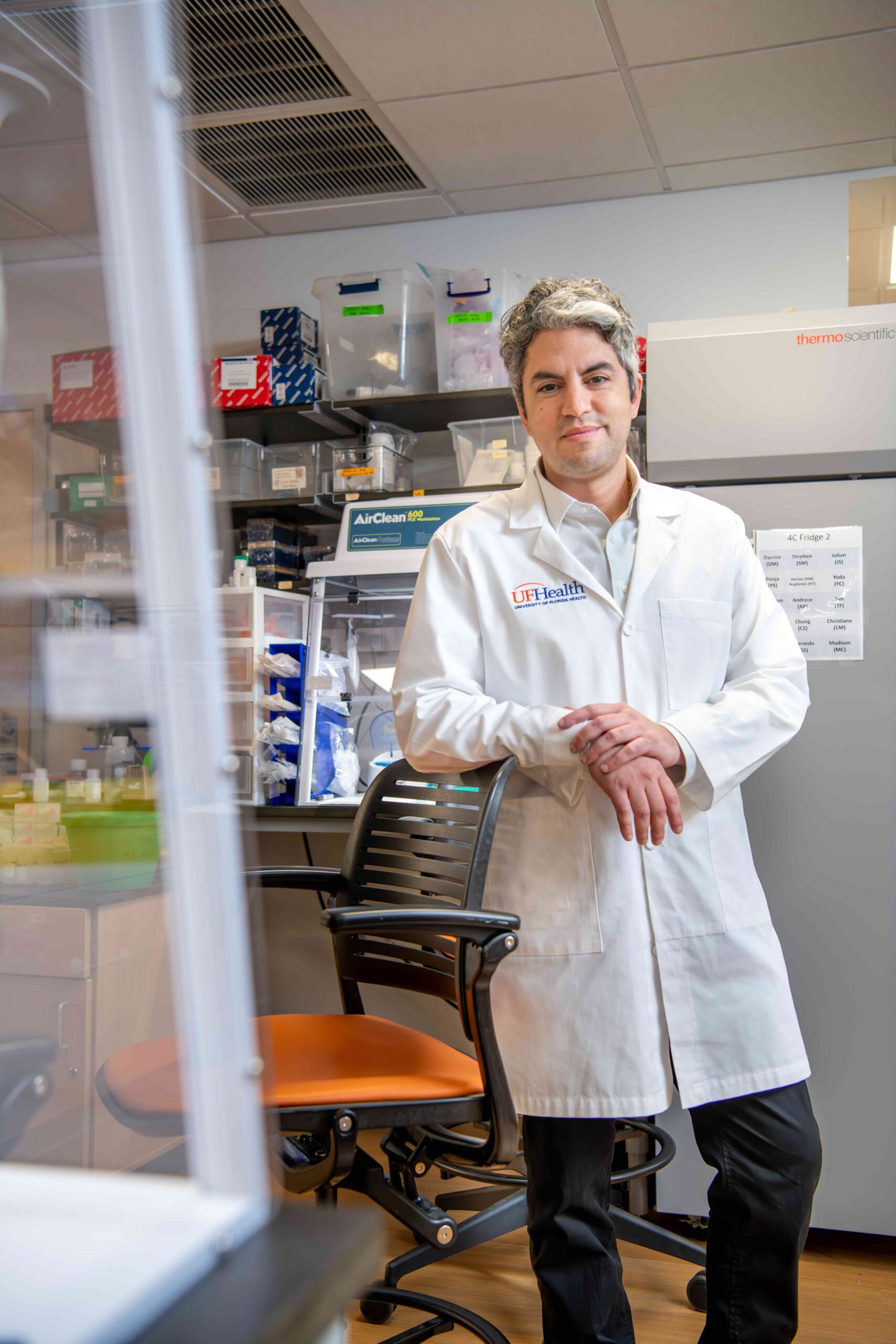
Now 44, Sayour runs his own lab that has grown to over 30 members, from junior faculty to undergraduate volunteers, and he continues to see patients too.
Parents of his patients often stay in touch. One couple made him a memorial photo album of their son, which Sayour keeps in his office near photos of his own three young children. Other parents, such as Cole Dooley, maintain a connection to Sayour through their joint advocacy for new treatments.
Dooley, a pediatric anesthesiologist, lost his 6-year-old daughter Phoebe in 2018 to diffuse intrinsic pontine glioma, or DIPG, a childhood brain tumor with a median survival of less than a year.
“Her hospitalizations were so crisis-centered, and I remember walking away from my interaction with Dr. Sayour thinking, oh my gosh, he was so calm, he was so personable,” says Dooley. “The way he tilts his head, you know that he’s listening to you. The way he interacted with my daughter was very caring. He’s just a very soft-spoken, gentle human being.”
One day last summer, amid changes to funding mechanisms at the National Institutes of Health, Sayour learned that a grant he had anticipated to support a clinical trial for patients with DIPG would not be awarded.
The news was deeply disappointing to him and to the families who turn to him in their darkest times.
“DIPG is such a difficult-to-treat tumor that they think finding out how to treat it could potentially lead to further treatments for many other diseases,” says Dooley. “These types of treatments hold a lot of hope for people who have had no options before.”
The next day, Sayour headed back to the lab, his sights set on moving closer to cures for children who are dying right now.
He had work to do, to find the journey’s end, in every step of the road.
Sources:
Elias Sayour, M.D., Ph.D.
Stop Children’s Cancer/Bonnie R. Freeman Professor for Pediatric Oncology Research
UF College of Medicine
Elias.Sayour@neurosurgery.ufl.edu